Why the Translation Method Is So Good for Learning German
Learn German by translating sentences from your own language. Discover why active recall makes this method so effective, and how to start.
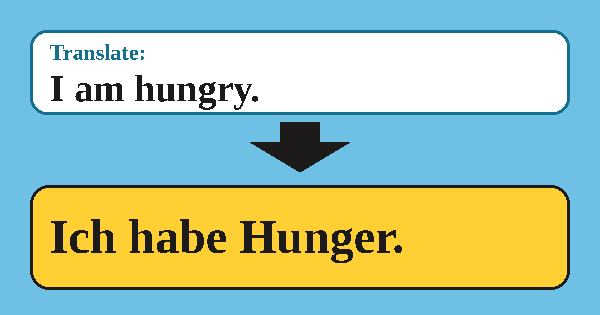
Many teachers say: “Don’t translate, just think in German!” It sounds great, but it is hard advice for a beginner. The good news is that there is a way to learn German by translating that actually trains you to speak. The trick is the direction: you do not translate German into your language to understand it. You translate from your language into German, and you do it from memory.
What is the translation method?
The idea is simple. You see a sentence in your own language. You try to say or write it in German. Only then do you check the correct answer. For example:
- I would like a coffee, please. → Ich hätte gern einen Kaffee.
- She has been living here for two years. → Sie wohnt seit zwei Jahren hier.
- If I had time, I would travel more. → Wenn ich Zeit hätte, würde ich mehr reisen.
Notice that the second sentence uses the present tense in German, while English needs “has been living”. You only discover such differences when you try to build the sentence yourself.
Why the translation method works so well
1. It forces you to produce, not just recognise
Reading a German sentence and thinking “yes, I understand” feels good, but it is easy. Producing the sentence is much harder and much more effective. Research on retrieval practice shows that trying to recall information helps memory more than simply reading it again. A translation exercise is exactly that: a small recall test for every sentence.
| Reading and recognising | Translating into German | |
|---|---|---|
| Effort | Low | High (in a good way) |
| Memory effect | Weak | Strong |
| Shows your gaps | Rarely | Immediately |
| Speaking practice | None | Yes |
2. It shows exactly what you do not know
When you cannot finish a translation, you have found a real gap: a missing word, a wrong article, an unknown verb form. This is valuable, because you now know what to study. In a normal lesson, such gaps stay hidden.
3. It trains grammar without a grammar book
To translate “I gave my sister a book”, you must choose the dative (meiner Schwester), the accusative (ein Buch) and the right word order: Ich habe meiner Schwester ein Buch gegeben. You practise three rules in one sentence, and you practise them in a real context.
4. It gives you instant, low-stress feedback
You do not need a partner or a teacher. You try, you compare with the correct sentence, and you see the difference at once. No one is listening, so mistakes cost nothing.
Does translating make you think in your native language?
At the beginning, yes, a little. That is normal, and it is not a problem. With repeated practice, the path from idea to German sentence becomes shorter and faster, and the translation step slowly disappears. If you want to speed this up, say the German sentence out loud and imagine the situation instead of the words.
How to use the translation method step by step
- Take a sentence in your own language at your level (A1–B2).
- Translate it into German from memory. Say it out loud or write it down.
- Compare with the correct German sentence.
- Mark the difference: a word, an article, an ending, the word order.
- Repeat the sentence tomorrow and again in three days.
How many sentences per day? Five to ten is enough. Ten minutes every day beats one long session per week.
Common mistakes
- Translating word for word. Translate the meaning of the sentence, not each word.
- Looking at the answer too early. Try for at least ten seconds first, even if you fail.
- Only translating into your language. That trains reading, not speaking.
Your turn
Translate these three sentences into German without looking anything up: “I am tired.”, “I live in Berlin.”, “Can you help me?” Then test yourself with real sentences and get instant feedback.