Stop Memorizing Word Lists: Why You Should Think in Full German Sentences
Learn German in sentences instead of word lists. See why full sentences beat vocabulary drills and how to start with simple daily practice.
You know 1,500 German words, but when someone asks “Wie geht’s?” your mind goes blank. Sound familiar? The problem is often not your memory. It is the method. If you learn German in sentences instead of word lists, your words come with grammar, rhythm and a real situation attached. That is what makes them usable.
Why vocabulary lists do not work for speaking
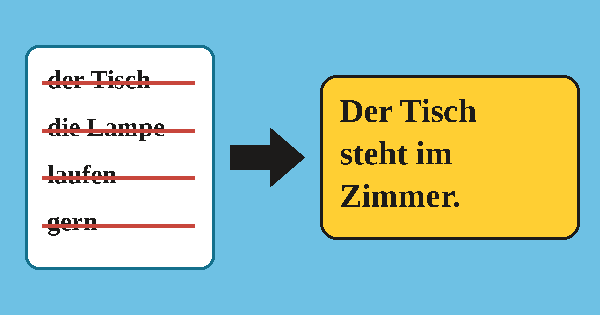
A list like der Tisch, die Lampe, laufen, gern looks efficient. But a single word is a lonely fact. Your brain has no reason to keep it, and no idea how to use it. In real life you never say “Tisch”. You say Der Tisch steht im Zimmer.
There is a second problem: German does not let you use words alone. Every noun needs an article, every verb needs the right ending, and the word order follows strict rules. A list teaches none of that.
What a full sentence teaches you at the same time
Compare what you get from one word and from one sentence:
| You learn | Word only: “Tisch” | Sentence: “Der Tisch steht neben dem Fenster.” |
|---|---|---|
| Article and gender | Only if you add it | Yes: der Tisch |
| Verb position | No | Yes: verb in second place |
| Case | No | Yes: neben dem Fenster (dative) |
| Useful partners | No | Yes: stehen, neben |
| Speaking rhythm | No | Yes |
Does this work for beginners?
Yes, and it is even easier at A1. Your sentences can be very short:
- Ich habe Hunger. – I am hungry.
- Ich laufe jeden Morgen im Park. – I run in the park every morning.
- Ich trinke gern Tee. – I like drinking tea.
At B1–B2, the idea is the same, only the sentences grow: Obwohl es regnet, gehe ich spazieren. (Although it is raining, I am going for a walk.) One sentence per new word is enough to start.
How to start thinking in German sentences
- Pick one new word. Include its article if it is a noun.
- Put it in a sentence about your own life. Ich habe einen Hund. is easier to remember than a sentence from a textbook.
- Say the sentence out loud. Your mouth remembers rhythm.
- Write it by hand or type it from memory the next day, without looking.
- Change one piece. Ich habe einen Hund. → Ich habe keinen Hund. → Hast du einen Hund?
Learn chunks, not single words
Native speakers talk in ready-made blocks: Ich hätte gern …, Wie lange dauert das?, Das kommt darauf an. Treat them like one big word. This is the fastest way to sound natural.
Are word lists completely useless?
No. For your first 100 to 200 basic words, a short list or flashcards are fine. The trick is to put a short example sentence on the back of every card. Then you use lists as a starting point, not as your whole method.
Common mistakes
- Writing sentences that are too complicated. A simple sentence you can remember beats a perfect sentence you forget.
- Translating from your own language word by word. Learn the German sentence as it is.
- Never saying the sentences aloud. Silent learning does not train speaking.
Your turn
Choose three words you learned this week and put each one in a sentence about your day. Then test yourself with real example sentences and get instant feedback.