German Modal Verbs: Können, Müssen, Wollen and More Explained
Learn German modal verbs können, müssen, wollen, dürfen, sollen and mögen with simple rules, example sentences and a clear word order.
“Ich kann Deutsch sprechen.” “Ich muss heute arbeiten.” “Darf ich hier sitzen?” Sentences like these are the building blocks of everyday German, and they all use German modal verbs. With just six little verbs you can talk about what you can, must, want, may and should do. Let’s make them simple.
What are the German modal verbs?
Modal verbs are helper verbs that change the meaning of the main verb. The six most important ones are:
- können – can, to be able to
- müssen – must, to have to
- wollen – to want to
- dürfen – may, to be allowed to
- sollen – should, to be supposed to
- mögen – to like (and möchten – would like)
How to conjugate German modal verbs
Modal verbs are irregular in the singular, but the pattern is the same for almost all of them: ich and er/sie/es have the same form, and there is no -e or -t ending.
| Infinitive | ich | du | er/sie/es | wir |
|---|---|---|---|---|
| können | kann | kannst | kann | können |
| müssen | muss | musst | muss | müssen |
| wollen | will | willst | will | wollen |
| dürfen | darf | darfst | darf | dürfen |
| sollen | soll | sollst | soll | sollen |
| mögen | mag | magst | mag | mögen |
Where does the second verb go?
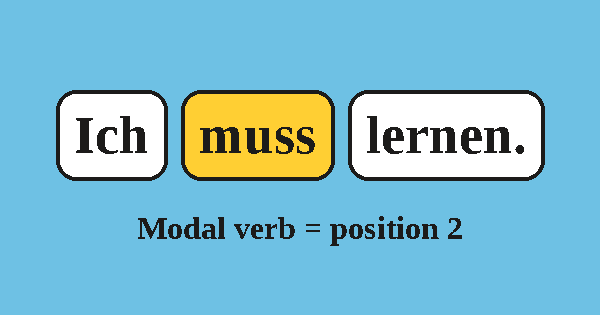
This is the most important rule. The modal verb takes the second position and the main verb goes to the end as an infinitive, without zu:
- Ich muss heute Deutsch lernen. – I have to learn German today.
- Kannst du mir helfen? – Can you help me?
- Morgen will ich früh aufstehen. – Tomorrow I want to get up early.
This is the same pattern as in the verb-second rule, only that now two verbs share the sentence.
The tricky pairs: müssen, dürfen and können
What is the difference between müssen nicht and nicht dürfen? This is the biggest trap for learners:
- Du musst nicht kommen. – You don’t have to come. (It is optional.)
- Du darfst nicht kommen. – You are not allowed to come. (It is forbidden.)
And können versus dürfen: Ich kann schwimmen says that you have the ability. Darf ich hier schwimmen? asks for permission.
Polite requests with möchten
Is mögen a modal verb? Yes, but in daily life you mostly use the form möchten to be polite: Ich möchte einen Kaffee, bitte. (I would like a coffee, please.) It sounds much friendlier than Ich will einen Kaffee., which can sound demanding.
Modal verbs in the past (B1–B2)
In writing, Germans usually use the simple past: Ich musste arbeiten. (I had to work.) In speech you can also hear the perfect tense with a double infinitive at the end: Ich habe arbeiten müssen. Learn this as a ready-made block and you are fine.
Common mistakes
- Adding zu. Wrong: Ich kann zu schwimmen. Right: Ich kann schwimmen.
- Putting the infinitive in the middle. Wrong: Ich muss lernen heute. Right: Ich muss heute lernen.
- Mixing up müssen nicht and nicht dürfen. Learn the two example sentences above as a pair.
Your turn
Write one sentence with each of the six modal verbs about your own day, for example Ich muss um sieben aufstehen. Then test yourself with real example sentences and get instant feedback.