How to Learn German Vocabulary (and Actually Remember It): 7 Steps + Free Word Lists A1–B2
Why German words don't stick, and a 7-step method that fixes it: learn by topic, with the article, in sentences, test yourself and review. With free word lists from A1 to B2.
You learned twenty new words on Monday. By Friday you remember five, and in a real conversation you can't find a single one. Sound familiar? The problem is rarely your memory. It is the way most people learn words: long alphabetical lists, no article, no context, no testing. In this guide you get a simple 7-step method for how to learn German vocabulary so that it stays, plus free German vocabulary lists by topic from A1 to B2 to start right away.
Why German words don't stick
- No context. A single word like Rechnung has nothing to hold on to. Die Rechnung, bitte! does.
- No article. If you learn Tisch instead of der Tisch, you will have to look it up again every time you need an ending.
- Only reading, never recalling. Reading a list feels productive, but your brain only stores a word when it has to find it.
- Too much at once. 100 words on Sunday beats nothing, but 10 words every day beats 100 on Sunday.
Step 1: Learn by topic and level
Words that belong together are easier to remember together. Learn the words for one situation, like the café, the doctor or the office, and you can use them right away in that situation. Start with the topics you need in your real life:
| Level | Topics to start with |
|---|---|
| A1 Beginner | Greetings and introductions, Food and drink, Numbers, time and calendar, Common verbs |
| A2 Elementary | At the doctor, Housing and moving, Jobs and the workplace, Common verbs |
| B1 Intermediate | Work and career, Opinions and discussions, Verbs with prepositions, Connectors and key nouns |
| B2 Upper intermediate | Workplace communication, Arguing and presenting, Noun-verb phrases, Idioms and expressions |
Our vocabulary overview has more than 70 topic lessons across all four levels, with over 700 words at A1 alone. Not sure which level is yours? Take the free level test first.
Step 2: Always learn the article
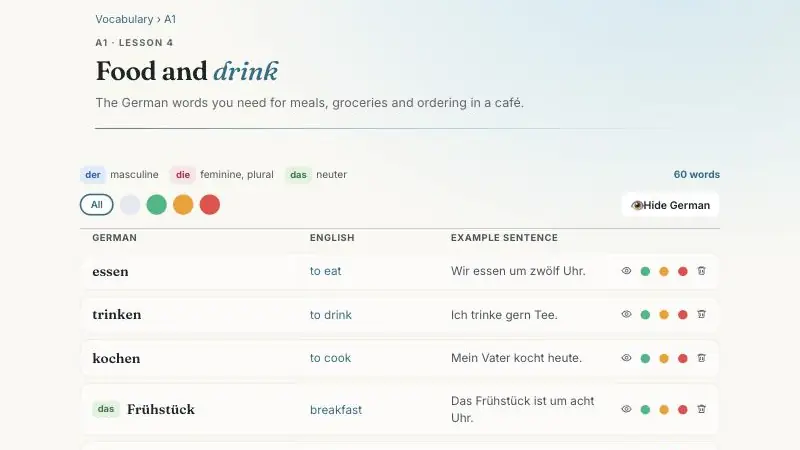
Never learn Brot. Learn das Brot. The article is part of the word, and without it you cannot build correct sentences later. In our lists every noun is colour-coded: der in blue, die in pink, das in green. Colours are easier to remember than letters. For the patterns behind the genders, read Der, die, das: 5 patterns that actually work.
Step 3: Learn every word in a sentence
A sentence gives the word a meaning, a grammar pattern and a picture in your head. Compare:
- die Rechnung – the bill
- Die Rechnung, bitte! – The bill, please!
The second one you can use tonight. That is why every word in our lists comes with a short German example sentence. More on this idea in Stop memorizing word lists: think in full sentences.
Step 4: Test yourself, don't just read
Reading a list ten times is much weaker than recalling a word once. So cover the German and try to remember it from the English. In every Sofapiano vocabulary lesson you can click "Hide German": the German words and sentences are blurred, you see only the English, and you reveal each word when you have said it out loud.
Step 5: Sort words by how well you know them
Not every word needs the same attention. Mark each word as you test yourself:
- Green: I know it.
- Orange: almost.
- Red: I don't know it yet.
Next time, filter the list and practise only the red and orange words. In our vocabulary lessons you can mark every word with these colours and filter by colour. With a free account your colours are saved, so you can pick up where you left off.
Step 6: Use the words actively
You only really own a word when you can produce it in your own sentence. The fastest way is translation: you read a sentence in English or Spanish and write it in German. That forces you to find the word, the article and the ending yourself. Read why in Why the translation method is so good, then practise with free translation exercises at your level.
Step 7: Review a little, but every day
Your brain forgets quickly at first and slowly later. So review new words the next day, a few days later and again after a week. A realistic plan:
- 5 minutes: 10 new words from one topic, with article and sentence.
- 5 minutes: hide the German and test yesterday's words.
- 5 minutes: translate a few sentences that use them.
Fifteen minutes a day is about 300 new words a month. If you like paper, writing the sentences by hand helps too: see Write German by hand.
Common mistakes
- Learning words alphabetically instead of by topic.
- Skipping the plural. der Apfel – die Äpfel is worth learning together.
- Learning verbs without their preposition. It is warten auf, sich freuen auf, Angst haben vor. Our B1 and B2 lists have whole lessons on verbs with prepositions.
- Never testing yourself. If you never hide the German, you only train recognition.
FAQ
How many German words should I learn per day?
About 10 new words a day is a good pace for most learners, as long as you also review the words from the last few days.
Are the Sofapiano word lists free?
Yes. All vocabulary lessons from A1 to B2 are free to use. With a free account you can also save the colours you give each word.
Should I learn words with English or German explanations?
At A1 and A2, a short English translation is fastest. From B1 on, the German example sentence becomes more and more important, because it shows how the word is really used.
Your turn
Pick one topic you need this week, learn ten words with their article and sentence, and test yourself tomorrow with "Hide German".