Always Learn Grammar in Context: Full Sentences with Translation
Learn German grammar in context with full sentences and translations. See how to understand rules faster and use them when you speak.
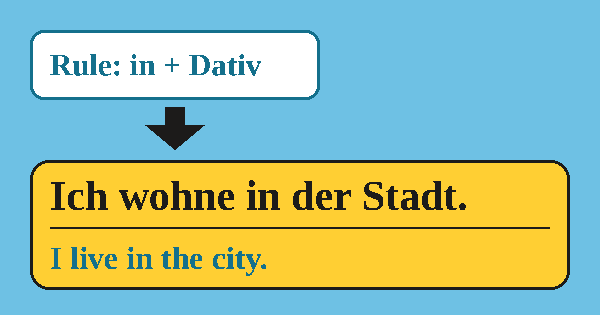
You studied the dative case three times, you can recite “mit, nach, bei, seit, von, zu, aus, gegenüber”, and yet you still say “Ich wohne in die Stadt.” Why? Because a rule in your head is not the same as a rule in your mouth. If you want to learn German grammar in context, you need full sentences and a clear translation, so that every rule has a meaning you can feel.
Why grammar rules alone do not stick
Grammar tables are useful for checking, but they are a poor way to learn. A table says dem, der, dem, den. It does not say when a real person would need der. Your brain cannot use a rule it has never seen at work.
Context solves this. When the same rule appears again and again inside natural sentences, you start to recognise the pattern before you can explain it. This is how children learn their first language, and it works for adults too.
What “grammar in context” really means
It means three things together: a full German sentence, its translation in your own language, and one thing to notice. Here is an example with the famous two-way prepositions:
| German | Translation | Notice |
|---|---|---|
| Ich wohne in der Stadt. | I live in the city. | Where? Dative |
| Ich fahre in die Stadt. | I am going into the city. | Where to? Accusative |
| Das Buch liegt auf dem Tisch. | The book is on the table. | Position: Dative |
| Ich lege das Buch auf den Tisch. | I put the book on the table. | Movement: Accusative |
Now the rule “movement = accusative, position = dative” is no longer a sentence in a book. You have seen four situations where it is true.
Why the translation matters
Is it a good idea to use translations when learning German? Yes, if you use them as a bridge and not as a crutch. The translation tells you instantly what the sentence means, so your attention can go to the grammar instead of guessing. This is especially helpful at A1–B1, when many structures are new.
The key is to read the German first, check the translation second, and then cover the German and say it again from the translation. That last step turns reading into speaking. Try to avoid word-by-word translation. German and English or Spanish often build a sentence in a different order, and that is exactly what you want to see.
One grammar point per level
- A1: Ich bin müde. – I am tired. (verb sein)
- A2: Ich habe gestern Pizza gegessen. – I ate pizza yesterday. (Perfekt, participle at the end)
- B1: Ich weiß, dass er morgen kommt. – I know that he is coming tomorrow. (verb at the end after dass)
- B2: Das Haus wurde 1990 gebaut. – The house was built in 1990. (Passiv Präteritum)
A simple way to practise grammar in context
- Choose one grammar topic, for example the dative.
- Read five sentences about that topic with their translations.
- Underline the part that shows the rule (the article, the ending, the verb position).
- Cover the German and say each sentence from the translation.
- Write one new sentence about your own life using the same pattern.
How many sentences do you need per grammar topic? Start with five to ten. It is better to meet one rule in ten different sentences than ten rules once.
Common mistakes
- Learning only the rule. You will understand it in a test but not in a conversation.
- Using sentences without translation. You may guess the meaning wrong and learn the wrong pattern.
- Jumping between too many topics. Stay with one pattern until it feels easy.
Your turn
Pick one rule you always forget and find three example sentences for it today. Then test yourself with real sentences, translations included, and get instant feedback.