How to Use Doch in German: Meaning, Examples and Rules
Learn how to use doch in German: say yes to negatives, soften requests and add emphasis. Clear examples for A1–B2 learners.
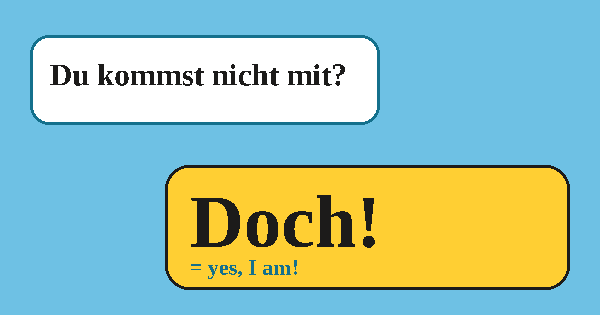
“Kommst du nicht mit?” – “Doch!” If you have ever heard this and felt lost, you are not alone. Learning how to use doch in German is one of the biggest steps from textbook German to real, natural German. The little word doch can mean “yes, I do!”, “please”, “you know” or even “I wish”. The good news: there are only a few patterns, and you can learn them one by one.
What does doch mean in German?
Doch has no single English translation. Its meaning depends on the situation and on your voice. There are four main jobs:
- It contradicts a negative (“Yes, I do!”).
- It softens a suggestion or request (“Come on, …”).
- It reminds someone of something they should know (“You know …”).
- It expresses a wish or impatience (“If only …!”).
Doch as a strong “yes” to a negative question
This is the most important use, and it starts at A1. When someone asks a question with nicht, kein or nie, and the true answer is “yes”, German uses doch instead of ja.
| Question | Answer | Meaning |
|---|---|---|
| Hast du keinen Hunger? | Doch, ich habe Hunger. | Yes, I am hungry. |
| Hast du keinen Hunger? | Nein, ich habe keinen Hunger. | No, I am not hungry. |
| Du kannst nicht schwimmen? | Doch, ich kann schwimmen! | Yes, I can swim! |
| Das ist nicht teuer. | Doch, das ist teuer! | It is expensive, I disagree! |
Is doch the same as ja? No. Ja agrees. Doch disagrees with what was said. That is why “Das ist nicht teuer.” – “Ja.” would be confusing, but “Doch!” is clear.
Doch to make requests and suggestions softer
Inside a sentence, doch is usually unstressed and friendly. With an imperative, it turns an order into an invitation.
- Komm doch mit! – Come along!
- Setz dich doch. – Do sit down.
- Probier doch mal den Kuchen. – Why don’t you try the cake?
- Ruf ihn doch an. – Just call him.
Without doch, “Komm mit!” sounds like an order. With doch, it sounds warm. You can hear the same effect in questions: Warum fragst du ihn nicht doch? or Können wir nicht doch ins Kino gehen? (“Can’t we go to the cinema after all?”).
Doch as a reminder: “You know …”
Sometimes doch means “I am sure you remember this”. It links a sentence to shared knowledge.
- Du weißt doch, dass ich Katzen liebe. – You know I love cats.
- Das habe ich dir doch gestern gesagt! – But I told you that yesterday!
- Er wohnt doch in Berlin, oder? – He lives in Berlin, doesn’t he?
This use can sound a little impatient when you say it with a sharp voice, so listen to the tone. A friendly tone means “remember?”, a sharp tone means “I already said that”.
Doch for wishes, surprise and “after all”
At B1–B2 you will meet doch in more emotional sentences:
- Wenn ich doch mehr Zeit hätte! – If only I had more time!
- Hätte ich doch früher angefangen. – I wish I had started earlier.
- Es hat doch geregnet. – It rained after all.
- Ich bleibe doch zu Hause. – I am staying at home after all.
And do not forget the old conjunction use: Er ist klein, doch er ist stark. (He is small, yet he is strong.) It is similar to aber, but more literary.
Where does doch go in a sentence?
As a short particle, doch usually stands in the middle of the sentence, after the verb and often after the pronoun: Du kannst doch Deutsch sprechen. As a single-word answer, it stands alone and gets the stress: “Doch!” As a conjunction, it stands in position zero, like aber: Ich wollte kommen, doch ich hatte keine Zeit.
Common mistakes with doch
- Using ja for a negative question. Say “Doch!”, not “Ja!”, when you disagree with the negative.
- Translating it word for word. Try to feel the purpose (soften, remind, wish) instead.
- Overusing it. One doch per sentence is enough.
Your turn
Write three answers to negative questions today: “Hast du keine Zeit?”, “Magst du keinen Kaffee?”, “Kannst du nicht kommen?” Answer each with Doch or Nein. Then practise more sentences and get instant feedback.