German Christmas Vocabulary: 30 Phrases for the Weihnachtsmarkt and the Holidays
Order Glühwein like a local, understand the Pfand, wish "Frohe Weihnachten" and "Guten Rutsch" correctly, and learn the German Christmas words you really need.
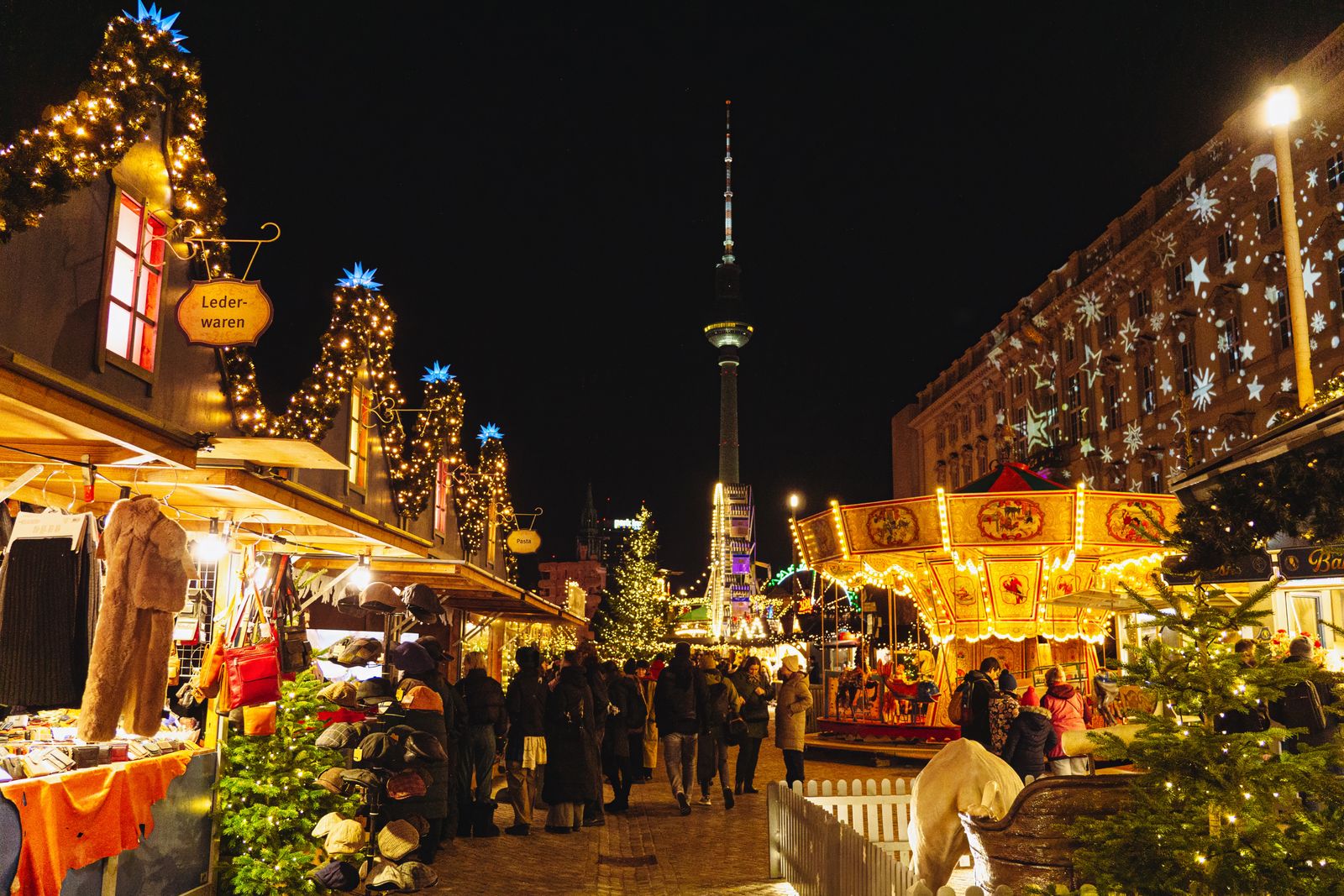
The lights go on, the stalls open, and the air smells of cinnamon, roasted almonds and mulled wine. Christmas in Germany starts at the end of November, and it is one of the best times to use your German in real life. In this article you get the German Christmas vocabulary you will actually need: phrases for the Christmas market, the most important words and traditions, and the right way to wish someone a merry Christmas and a happy new year. As always, in full sentences with translation.
At the Weihnachtsmarkt: ordering food and drinks
The Weihnachtsmarkt (Christmas market) is the heart of the German Christmas season. These sentences get you through the evening:
- Einen Glühwein, bitte. – A mulled wine, please.
- Zwei Kinderpunsch, bitte. – Two non-alcoholic punches, please.
- Mit Schuss, bitte. – With a shot (of rum or liqueur), please.
- Was kostet ein Glühwein? – How much is a mulled wine?
- Einmal gebrannte Mandeln, bitte. – One bag of roasted almonds, please.
- Eine Bratwurst mit Senf, bitte. – A bratwurst with mustard, please.
- Kann ich mit Karte zahlen? – Can I pay by card?
- Das ist für mich, und das ist für meine Freundin. – This is for me, and this is for my friend.
Notice the accusative in einen Glühwein: der Glühwein is masculine, so after ich möchte or bitte it becomes einen. If that still trips you up, read our guide to accusative vs. dative.
The Pfand: why your mug costs extra
Your Glühwein usually comes in a ceramic mug, and you pay a Pfand (deposit) for it. You get the money back when you return the mug, or you keep it as a souvenir:
- Wie viel Pfand ist auf der Tasse? – How much is the deposit on the mug?
- Ich möchte die Tasse zurückgeben. – I would like to return the mug.
- Ich behalte die Tasse. – I'll keep the mug.
The most important Christmas words
Learn every noun with its article. That saves you a lot of trouble with endings later (see der, die, das).
| German | English | Example sentence |
|---|---|---|
| der Advent | Advent | Im Advent backen wir Plätzchen. – In Advent we bake cookies. |
| der Adventskranz | Advent wreath | Am Sonntag zünden wir die zweite Kerze am Adventskranz an. – On Sunday we light the second candle on the Advent wreath. |
| der Adventskalender | Advent calendar | Die Kinder öffnen jeden Morgen ein Türchen im Adventskalender. – The kids open a little door in the Advent calendar every morning. |
| die Plätzchen (pl.) | Christmas cookies | Die Plätzchen sind noch warm. – The cookies are still warm. |
| der Weihnachtsbaum | Christmas tree | Wir schmücken den Weihnachtsbaum am 24. Dezember. – We decorate the Christmas tree on December 24th. |
| das Geschenk | present | Ich habe noch kein Geschenk für meinen Bruder. – I don't have a present for my brother yet. |
| der Heiligabend | Christmas Eve | An Heiligabend essen wir bei meinen Eltern. – On Christmas Eve we eat at my parents' place. |
| die Bescherung | giving of presents | Die Bescherung ist bei uns nach dem Abendessen. – At our place, presents are opened after dinner. |
| der Stollen | Christmas fruit bread | Möchtest du noch ein Stück Stollen? – Would you like another piece of Stollen? |
| der Lebkuchen | gingerbread | Auf dem Markt gibt es Lebkuchenherzen. – There are gingerbread hearts at the market. |
Traditions you should know
- Nikolaus (6 December): The evening before, children put their boots outside the door. In the morning they find sweets inside. Hast du deine Stiefel schon rausgestellt? – Have you put your boots out yet?
- Heiligabend (24 December): This is the big evening in Germany. Presents are usually opened on the 24th, not on the morning of the 25th.
- Christkind or Weihnachtsmann? Depending on the region and the family, the presents are brought by the Christkind or by the Weihnachtsmann (Santa Claus).
- Two holidays: 25 and 26 December are both public holidays: der erste und der zweite Weihnachtsfeiertag.
- Silvester (31 December): New Year's Eve, with fireworks at midnight and lots of Prost!
Christmas and New Year wishes
These are the wishes you will hear everywhere in December:
- Frohe Weihnachten! – Merry Christmas!
- Fröhliche Weihnachten! – Merry Christmas! (a bit more traditional)
- Schöne Feiertage! – Happy holidays!
- Einen guten Rutsch! – Have a good start into the new year! (said before 1 January)
- Frohes neues Jahr! – Happy New Year! (said from 1 January)
- Ein gesundes neues Jahr! – A healthy new year!
For a card or a message to colleagues:
- Ich wünsche dir frohe Weihnachten und einen guten Rutsch ins neue Jahr! – I wish you a merry Christmas and a good start into the new year!
- Wir wünschen Ihnen schöne Feiertage und alles Gute für das neue Jahr. – We wish you happy holidays and all the best for the new year.
Grammar bonus: all these wishes are accusative, because there is a hidden Ich wünsche dir… in front. That is why it is einen guten Rutsch (masculine accusative) and ein gesundes neues Jahr (neuter). More on this in our guide to German adjective endings. And for dir or Ihnen, read du or Sie?
Small talk in December
- Was machst du an Weihnachten? – What are you doing for Christmas?
- Ich fahre über die Feiertage zu meiner Familie. – I'm going to my family over the holidays.
- Was wünschst du dir zu Weihnachten? – What do you want for Christmas?
- Hast du schon alle Geschenke? – Have you got all your presents yet?
- Gehen wir nach der Arbeit auf den Weihnachtsmarkt? – Shall we go to the Christmas market after work?
- Feierst du Weihnachten? – Do you celebrate Christmas?
Small tip: in southern Germany and Austria people say an Weihnachten, in the north often zu Weihnachten. Both are correct.
Your turn
Write three sentences about your own Christmas or holiday season: what you eat, who you see and what you wish someone. For example: An Heiligabend esse ich mit meiner Familie. Then practise with real example sentences and get instant feedback on every word.