What Is My German Level? Find Out with a Free Test (A1–B2)
Not sure if you are A1, A2, B1 or B2? Here is what each level means, why most online tests get it wrong, and how our free German level test shows your real level.
You have been learning German for a while. You can order a coffee, you understand parts of a podcast, and you know what the dative is. But when someone asks "What is your level?", you hesitate. A2? B1? Somewhere in between? Knowing your real German level matters: it decides which course you book, which exam you can pass and what you should practise next. In this article you will learn what the levels mean and how to find yours in one sitting with our free German level test.
The four levels: A1, A2, B1 and B2
German levels follow the Common European Framework of Reference (CEFR). Here is the short version, with an example sentence you should be able to say at each level:
| Level | What you can do | Typical sentence |
|---|---|---|
| A1 Beginner | Introduce yourself, ask simple questions, understand slow, clear speech. | Ich heiße Anna und wohne in Berlin. |
| A2 Elementary | Talk about your day, the past and your plans; handle shops, doctors and travel. | Gestern bin ich mit dem Zug nach Hamburg gefahren. |
| B1 Intermediate | Give reasons and opinions, tell a story, cope with most everyday situations. | Ich lerne Deutsch, weil ich in Österreich arbeiten möchte. |
| B2 Upper intermediate | Discuss abstract topics, follow the news, speak fluently with native speakers. | Wenn ich mehr Zeit gehabt hätte, hätte ich das Projekt anders geplant. |
Want to see the grammar behind each level? Our guide to German grammar by level lists every topic in a sensible order.
Why most online tests get your level wrong
Most free tests are multiple choice. You see four options and click the one that looks right. That measures recognition: can you spot the correct answer? But in real life nobody gives you four options. You have to produce the sentence yourself, with the right word order, the right ending and the right spelling.
That is why so many learners "test" at B1 and then freeze in their first real conversation. Recognising German and producing German are two different skills, and only the second one shows your real level.
How the sofapiano level test works
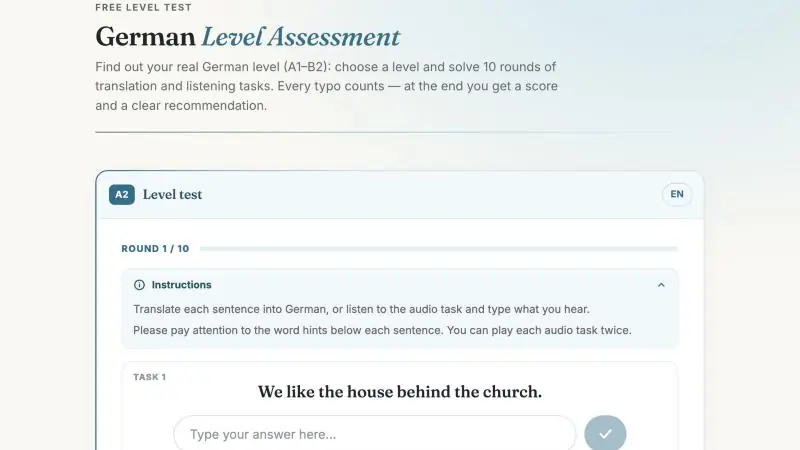
Our German level test is built around that idea. Instead of clicking answers, you write real German:
- Choose a level. Pick A1, A2, B1 or B2, the level you want to check.
- Solve 10 rounds. Each round has three tasks, so 30 tasks in total.
- Translate sentences. You see a sentence like "We like the house behind the church." and type it in German. Small word hints below the sentence show the first letter of each word, so you know how many words you need.
- Listen and write. In the listening tasks you hear a German sentence and type what you hear. You can play each audio twice.
- Get your result. Every typo counts, just like in a real exam. At the end you get a score and a clear recommendation.
The sentences are the kind native speakers actually use, not textbook phrases. That makes the test harder than a multiple-choice quiz, but much more honest.
Which level should you choose?
- Never had a course? Start with A1.
- Finished one or two beginner courses? Try A2.
- You can talk about the past and give reasons with weil? Try B1.
- You read German articles and watch German series? Try B2.
Not sure? Start one level lower than you think. If the test feels easy, take the next level right after. Your real level is the highest one you pass with a good score.
Tips for an honest result
- No translator, no dictionary. The goal is to see where you are, not to get a high score.
- Use headphones for the listening tasks and find a quiet place.
- Write full sentences carefully. Check capital letters for nouns and verb position before you submit.
- Look at your mistakes. They show you exactly what to practise next, for example word order, cases or adjective endings.
What to do with your result
Your level is a starting point, not a label. Once you know it:
- Practise with translation exercises at your level, so you train exactly the skill the test measures.
- Fill the grammar gaps the test revealed. Typical weak spots are accusative vs. dative, word order and adjective endings.
- Plan your time. Our article How long does it take to learn German? shows realistic hours for each level.
- Preparing for an exam? Read what to expect in the Goethe B1 exam.
- Repeat the test every few weeks to see your progress.
FAQ
Is the German level test free?
Yes. You can take the test for every level from A1 to B2 for free.
How many tasks are there?
10 rounds with three tasks each, so 30 tasks: translations and listening tasks.
Is this an official certificate?
No. The test shows you where you stand, so you can choose the right course or exam. For an official certificate you need an exam such as Goethe, telc or ÖSD.
Why does a typo count as a mistake?
Because it does in real exams and in real emails, too. Haus and haus are not the same in German, and neither are dem and den.
Your turn
Ten rounds, thirty sentences, one honest answer to the question "What is my German level?"