Skip to content
  • German A1
    • Mixed Translations
    • Grammar-Specific Translations
  • German A2
    • Mixed Translations
    • Grammar-Specific Translations
  • German B1
    • Mixed Translations
    • Grammar-Specific Translations
  • German B2
    • Mixed Translations
    • Grammar-Specific Translations

Author: admin

How Long Does It Take to Learn German? (A1 to B2, Realistically)

Hourglass on a wooden table – how long does it take to learn German from A1 to B2

How long does it take to learn German? Realistic hours and timelines for A1, A2, B1 and B2, based on Goethe-Institut guidelines, plus tips to get there faster.

German Two-Way Prepositions: Wo or Wohin? (Accusative or Dative Made Easy)

Cat sitting on a wooden table next to a window – German two-way prepositions: Die Katze sitzt auf dem Tisch

In, auf, an, unter: accusative or dative? Learn the simple Wo or Wohin question behind German two-way prepositions, with verb pairs, examples and common mistakes.

The 10 Most Common German Mistakes for English and Spanish Speakers (and How to Fix Them)

Red stop sign – stop making the most common mistakes in German

The 10 most common German mistakes made by English and Spanish speakers, with wrong and right sentences and a quick fix for each one.

German Perfekt: When to Use Haben and When to Use Sein

Travelers waiting on a train station platform – Perfekt with sein: Ich bin gefahren

Haben or sein in the German Perfekt? Learn the simple rule for the past tense, how to build the participle, and the most common mistakes, with clear examples.

Why “Halb Drei” Means 2:30: German Time Telling Explained

Close-up of an analog wall clock face with numbers

Does “Es ist halb drei” mean 2:30 or 3:30? Learn how German time telling works, from halb and Viertel to the 24-hour clock, with simple rules and examples.

Wenn, Als, Ob: The 3-Second Trick to Never Mix Them Up Again

Street signs on a pole pointing in different directions

Wenn, als or ob? Use a simple 3-step trick to pick the right German word for “if”, “when” and “whether”, with clear examples and common mistakes.

Mal, Ja, Eben, Halt: The German Filler Words That Make You Sound Native

Two women chatting in a café

Mal, ja, eben, halt, denn, eigentlich: learn the German modal particles that make your German sound natural, with simple rules and everyday examples.

Kennen vs. Wissen: Two German Ways to Say “I Know”

Two people shaking hands in front of a green garden – meeting someone new, symbol for the German verb kennen

Ich kenne Anna. Ich weiß, wo sie wohnt. Learn when to use kennen and when to use wissen, with simple rules and examples.

Tun in German: The Tiny Verb That Does It All (Do, Hurt, Sorry and More)

Person schreibt eine To-do-Liste in ein Notizbuch – Symbolbild für das Verb „tun“

One small verb, three meanings: learn how to conjugate tun and use it in Das tut weh, Es tut mir leid and other everyday phrases.

German Modal Verbs: Können, Müssen, Wollen and More Explained
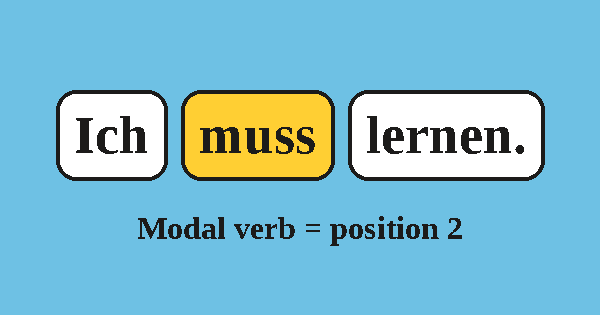
German sentence "Ich muss lernen." with the modal verb in position 2 – German modal verbs

Learn German modal verbs können, müssen, wollen, dürfen, sollen and mögen with simple conjugation tables, word order and example sentences.

Next →
  • Privacy Policy
  • Terms & Conditions
  • Cookie Notice
  • Impressum
Manage consent
To give you the best experience, we use technologies like cookies to store and/or access device information. Consenting allows us to process data such as browsing behaviour or unique IDs on this site. Not consenting or withdrawing consent may affect certain features and functions.
Functional Always active
The technical storage or access is strictly necessary for the legitimate purpose of enabling the use of a specific service explicitly requested by the user, or for the sole purpose of carrying out the transmission of a communication over an electronic network.
Preferences
The technical storage or access is necessary for the legitimate purpose of storing preferences that are not requested by the user.
Statistics
The technical storage or access that is used exclusively for statistical purposes. The technical storage or access that is used exclusively for anonymous statistical purposes.
Marketing
The technical storage or access is required to create user profiles to send advertising, or to track the user on a website or across several websites for similar marketing purposes.
  • Manage vendors
  • Read more about these purposes
  • Privacy Policy
  • Impressum